 Changelly
: Network Checks Before Buying or Swapping
Changelly exchanges cryptocurrency and arranges purchases through payment providers, with bought or exchanged assets delivered to a supplied wallet address. A usable transaction requires matching assets, supported networks, and a compatible destination. Swaps also depend on the selected rate conditions; purchases depend on the provider's payment and verification requirements. Before committing funds, establish what the destination accepts and what the order requires, then check the delivered asset against that order.
Key takeaway: A compatible receiving address must match the selected asset and network, including any memo or destination tag that the destination requires.
Exchange orders, payment providers, and receiving wallets
Changelly's standard exchange connects the cryptocurrency you send with the cryptocurrency you want to receive, while your receiving wallet supplies the destination. The exchange creates payment instructions for the input asset. Its payout goes to the recipient address entered for that order. This arrangement suits a direct conversion when the desired pair and networks are available and you meet Changelly's eligibility requirements, including its location restrictions.
A purchase starts with fiat currency, meaning conventional money paid through a supported payment method. The selected purchase provider handles payment processing and its verification requirements. Available offers depend on the purchase details and eligibility. Buying therefore introduces a payment relationship alongside the blockchain transfer that delivers the cryptocurrency.
Selling reverses that broad direction: a supported provider receives cryptocurrency and arranges a fiat payout under its own conditions. Availability for buying does not establish availability for selling. Across these services, distinguish the company processing the order from the wallet or account receiving the proceeds.
Asset, network, address, and memo
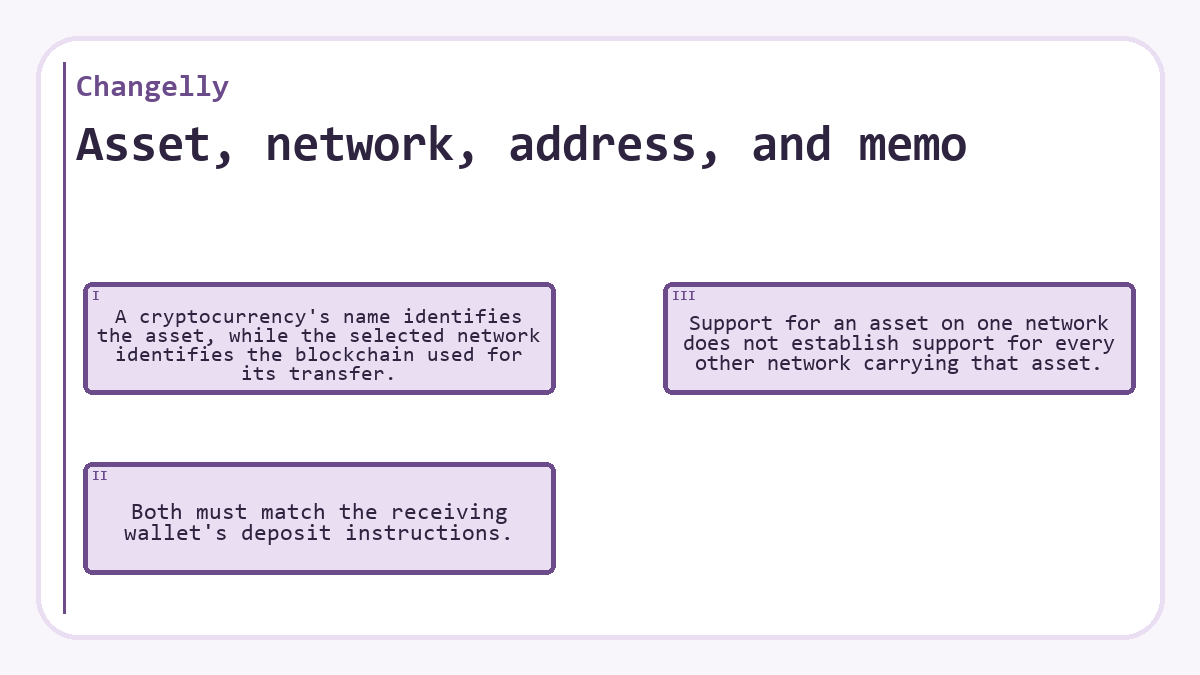
A cryptocurrency's name identifies the asset, while the selected network identifies the blockchain used for its transfer. Both must match the receiving wallet's deposit instructions. Support for an asset on one network does not establish support for every other network carrying that asset.
An address can pass a format check without supporting the network selected for a Changelly payout. Matching the visible characters therefore does not complete the compatibility check. Compare the network named in the order with the network named by the destination. For an exchange, the sending network must also match the order's deposit instructions. The input and output can use different supported networks, so check each side separately.
A memo or destination tag is an additional identifier that some deposits require alongside the address. A receiving service may use it to assign a transfer to the correct account. Use the exact identifier when the destination requires one. The deposit instructions for the cryptocurrency you send may also contain an extra identifier; that belongs to the incoming payment, not automatically to the payout.
Fixed and floating quotes before funding
A fixed-rate exchange offers a defined quoted outcome subject to its funding conditions, including the amount received and the order's payment deadline. The incoming transfer must meet the timing requirement shown for that order. A wallet's send confirmation alone does not establish that the transfer appeared on the blockchain within that window.
A floating-rate exchange allows the final received amount to change with market conditions during processing. This distinction matters when choosing between output predictability and accepting a changing quote. Neither rate option corrects a network mismatch, removes verification requirements, or guarantees a completion time.
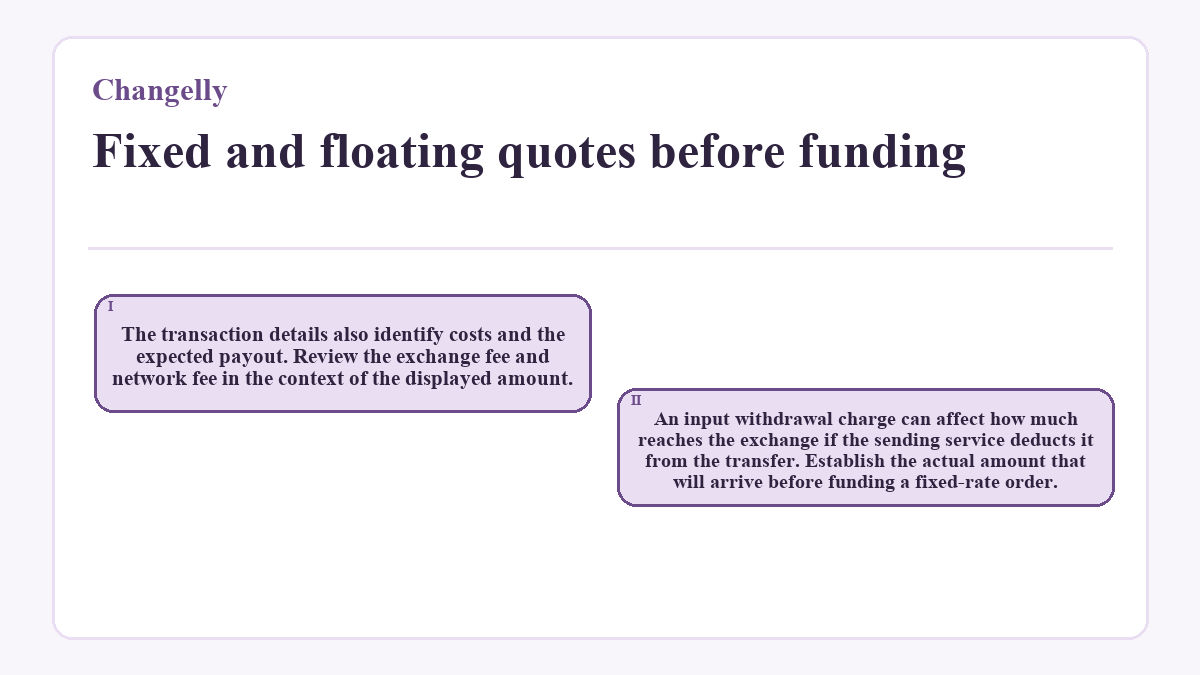
The transaction details also identify costs and the expected payout. Review the exchange fee and network fee in the context of the displayed amount. An input withdrawal charge can affect how much reaches the exchange if the sending service deducts it from the transfer. Establish the actual amount that will arrive before funding a fixed-rate order.
Purchase eligibility and verification requirements
A purchase offer is usable only when its provider supports the relevant country, payment method, currency, and transaction amount. Review those conditions before authorizing payment. A displayed offer does not establish that the bank will approve the charge or that identity checks are complete.
Purchase verification follows the selected provider's requirements. Processing time can include payment approval, provider checks, and blockchain delivery. Keep the provider's order details because its records identify the payment and purchase status. A successful charge and a completed cryptocurrency delivery describe different events.
Changelly may place a cryptocurrency exchange on hold for identity verification. Know Your Customer, usually shortened to KYC, can involve an identity document and additional information about the origin of funds. Verification is not compulsory for every standard exchange, but an initial quote does not exempt an order from later review.
That possibility affects both timing and privacy. Consider whether supplying the requested identity and transaction records is acceptable before sending funds.
Checks before committing a fixed-rate swap
Before funding a fixed-rate swap, check that your sending wallet can meet the order's amount and timing requirements and that your destination accepts the payout.
- Match the input asset and network to the order's deposit instructions.
- Match the output asset and network to the destination's receiving instructions.
- Include each required memo or destination tag on the correct side of the exchange.
- Confirm that the amount reaching the deposit address will match the order and that the transfer can appear on the blockchain before its payment deadline.
- Check the expected payout and retain the order details needed to identify the exchange.
After those conditions match, submitting the outgoing transfer commits cryptocurrency to the order. Keep its transaction hash alongside the exchange order ID. The hash identifies the blockchain transfer; the order ID identifies the exchange request. Use the order ID to track the exchange and distinguish the incoming transfer's hash from the eventual payout hash.
The expected outcome is the order's payout asset arriving at the specified destination on the selected network. Compare the payout record with the receiving wallet's transaction history and credited amount before making another transaction that relies on those funds.
If the exchange reports completion but the receiving wallet shows no credit, pause that next transaction. Inspect the payout hash, destination, and network, then ask the receiving service about any crediting delay. Sending another deposit does not resolve a missing payout display.
Delayed transfers and the limits of recovery
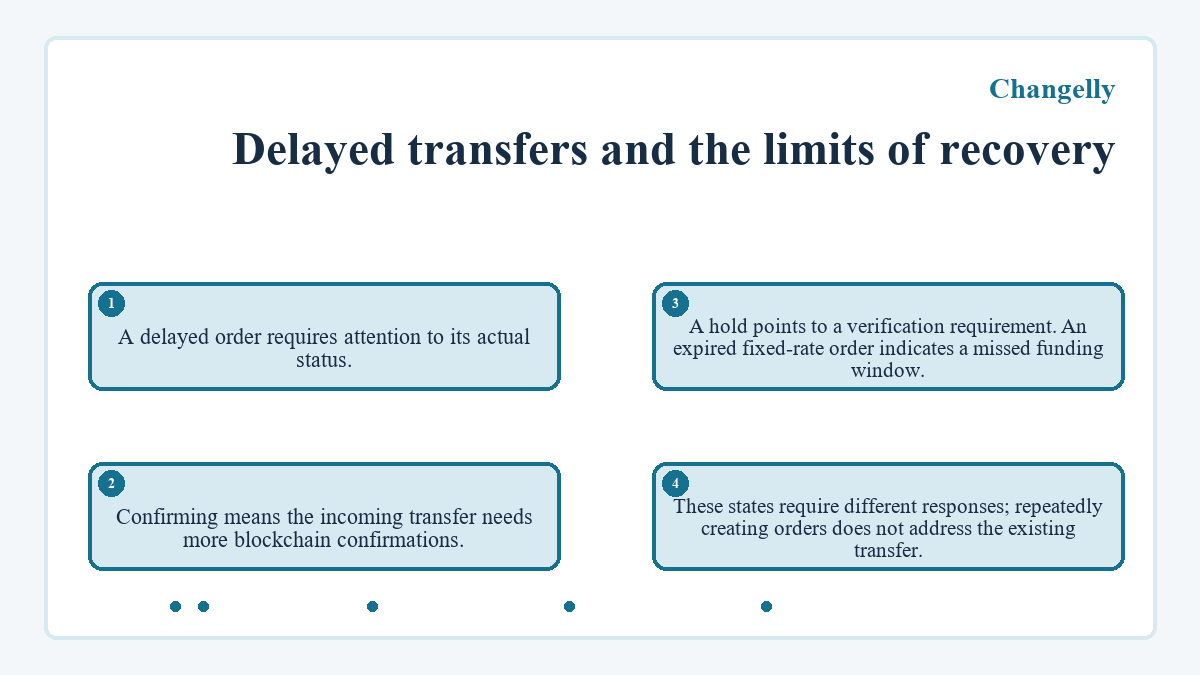
A delayed order requires attention to its actual status. Confirming means the incoming transfer needs more blockchain confirmations. A hold points to a verification requirement. An expired fixed-rate order indicates a missed funding window. These states require different responses; repeatedly creating orders does not address the existing transfer.
Late payments, incorrect amounts, or missing deposit identifiers may require manual support. Provide the exchange order ID and relevant transaction hash so support can identify the payment. Do not assume that a second transfer will complete an underfunded order. Recovery depends on what arrived, where it arrived, and whether the service can process or return it.
A wrong recipient address creates a different limit. Before payout, support may be able to intervene, although stopping the exchange is uncertain. Once the payout transfer has been sent, cancellation is unavailable. Funds sent over an unsupported network may require help from the receiving wallet or service, and recovery may be impossible. The next decision should follow the transfer's actual state: wait for confirmations, answer a verification request, or seek help for the specific mismatch.
Changelly questions worth asking
-
May I reuse the deposit address from an earlier Changelly exchange?
- Create a new exchange order instead of sending cryptocurrency to a previously used deposit address. Each order has its own payment instructions and funding window. A transfer to an old address may require manual handling, and the earlier quote does not carry over to the new payment.
-
What determines the minimum amount for a swap?
- The minimum reflects the selected pair's exchange requirements and the cost of processing its network transfer. Use the limit displayed for the intended order. Sending less than that amount can prevent automatic processing, and a deposit too small to cover the return network fee may be non-refundable.
-
Why is an asset unavailable for exchange?
- An asset or pair can become unavailable because of maintenance, liquidity constraints, or problems affecting an exchange partner. Availability can change between transactions. An earlier successful exchange does not establish that the same pair or network is available for another order.
-
Does a rejected card payment mean the recipient address is wrong?
- A rejected card payment does not by itself identify a recipient-address problem. The bank may decline cryptocurrency purchases, payment authentication may fail, or the provider may reject the payment under its conditions. Use the decline information from the bank or purchase provider to distinguish payment problems from wallet compatibility.
-
Will completing KYC in advance prevent every later verification request?
- Completing KYC in advance does not prevent Changelly from requesting additional verification for a later exchange. Prior verification establishes an account's verification record, but further checks can still apply to a transaction. A purchase provider also applies its own requirements, which are separate from verification for the standard exchange service.