 Changelly
 fees reduce swap proceeds through service charges and network deductions
Changelly fees include the exchange service charge and the network deduction associated with delivering your payout. Your sending wallet or exchange can also charge for funding the order. The total depends on the rate option, the selected assets and networks, and whether a partner handles the exchange. Compare the net receiving amount for the same input, then account for any sending cost outside that quote. A service percentage alone does not describe the full conversion cost.
In short: Compare the cryptocurrency that reaches your wallet with the full cost of funding the swap, using matching assets and networks.
Service charges and payout network deductions
Changelly's exchange charge pays for the conversion service, while the payout network deduction covers the cost associated with transferring the resulting cryptocurrency.
The exchange service charge
Floating exchanges use a percentage service charge, whereas fixed exchanges incorporate dynamic pricing for the protected quote. Partner transactions can have different charges. The applicable order details matter because a percentage advertised for one transaction type does not establish the cost of another. Keep the service charge separate in your accounting, even when the receiving estimate already includes it.
The outgoing transfer charge
Changelly passes network withdrawal charges to the exchanges that execute the outgoing transfers. The displayed charge starts as an estimate, and the final network charge can differ. It therefore need not equal a wallet's estimate for an ordinary transfer on the same blockchain. The customer bears this cost through the exchange payout.
Fixed, floating, and partner exchange quotes
Floating and fixed quotes handle market movement differently, while a partner integration can add another service charge to either available rate option.
| Exchange option | Service pricing | Receiving amount | Condition affecting execution |
|---|---|---|---|
| Direct floating exchange | Percentage service charge | Estimate changes with the execution rate | The deposit must satisfy the order's amount requirements |
| Direct fixed exchange | Dynamic charge within the quote | Protected against market movement under the order conditions | The required amount must arrive within the funding conditions |
| Exchange through an API partner | Changelly charge and any configured partner commission | Depends on the selected rate mode and network deduction | The integration's supported pair and transaction limits apply |
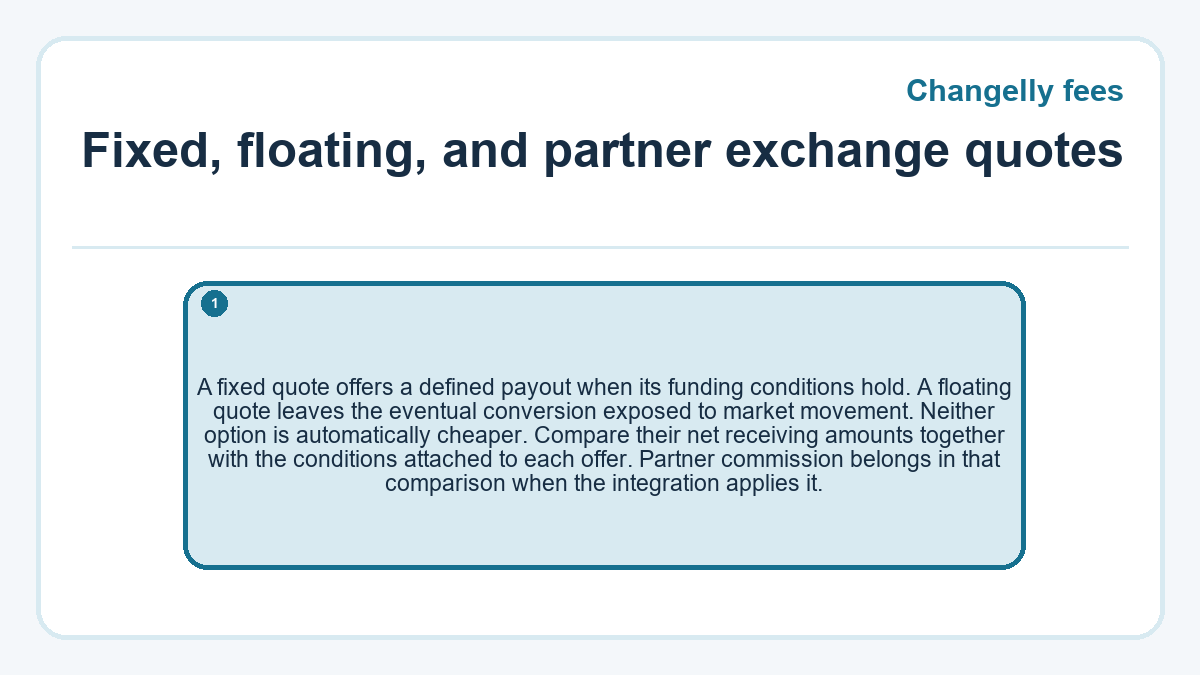
A fixed quote offers a defined payout when its funding conditions hold. A floating quote leaves the eventual conversion exposed to market movement. Neither option is automatically cheaper. Compare their net receiving amounts together with the conditions attached to each offer. Partner commission belongs in that comparison when the integration applies it.
The separate cost of funding the deposit
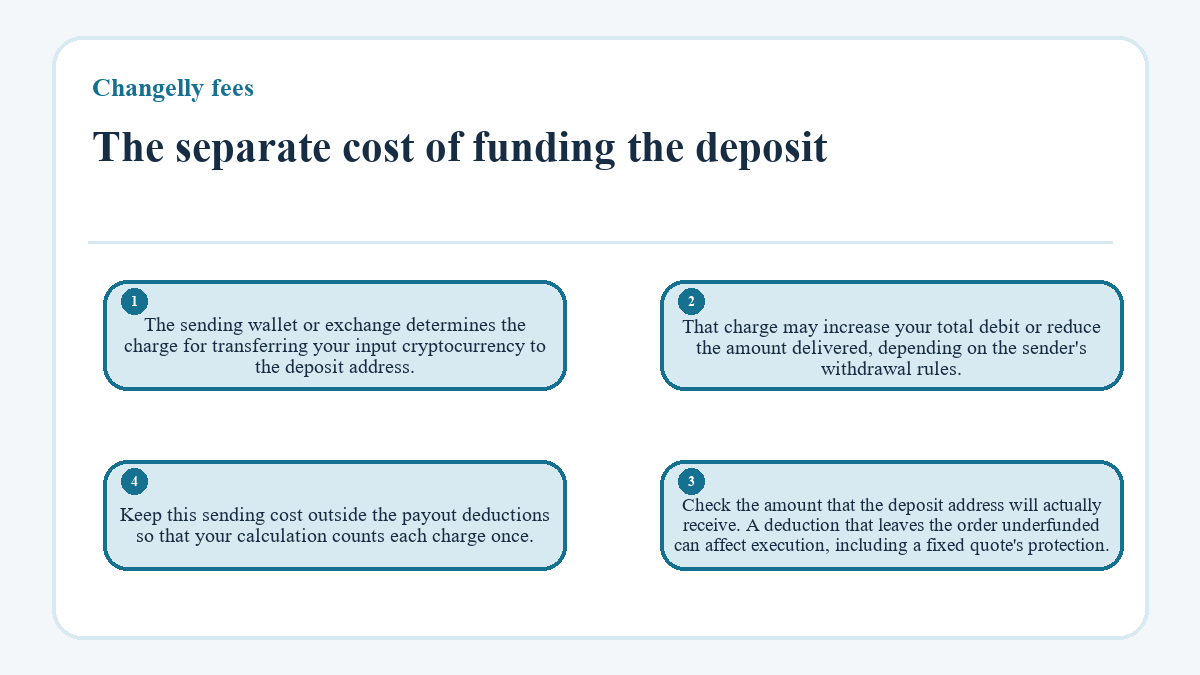
The sending wallet or exchange determines the charge for transferring your input cryptocurrency to the deposit address. That charge may increase your total debit or reduce the amount delivered, depending on the sender's withdrawal rules. Check the amount that the deposit address will actually receive. A deduction that leaves the order underfunded can affect execution, including a fixed quote's protection. Keep this sending cost outside the payout deductions so that your calculation counts each charge once.
Exchange rates and the cost beyond itemized fees
A difference between a quoted rate and a comparison rate changes the value of the swap, even without a separate fee line. That difference may reflect pricing, liquidity, market movement, or unlike quote conditions. It does not, by itself, prove an undisclosed service charge. Changelly's floating estimate can change before conversion finishes.
Use a comparison rate captured near the quote time, with the same conversion direction. A market price observed later mixes execution cost with subsequent price movement. For an all-in cost expressed as a percentage, value the total input debit and net output at one consistent reference time. Subtract the net output value from the total input value, divide by the total input value, and multiply by 100. This is a comparison measure, not a calculation of Changelly's service revenue.
A lower explicit fee can coexist with a less favorable conversion rate.
Network compatibility and usable proceeds
A payout only meets the intended task when the destination accepts both its asset and its network. A cheaper transfer on an incompatible network is not an equivalent alternative. Limit cost comparisons to networks that the order and destination both support. If that overlap is absent, stop before funding and reassess the available route. Sending through an unsupported network can leave recovery uncertain and introduce additional costs.
Why do small swaps lose a larger share to fees?
Small swaps can lose a larger share to fees because a transfer charge does not necessarily shrink in proportion to the amount exchanged. A similar absolute network deduction consumes a greater fraction of a smaller payout. The service percentage and the network deduction therefore respond differently to transaction size.
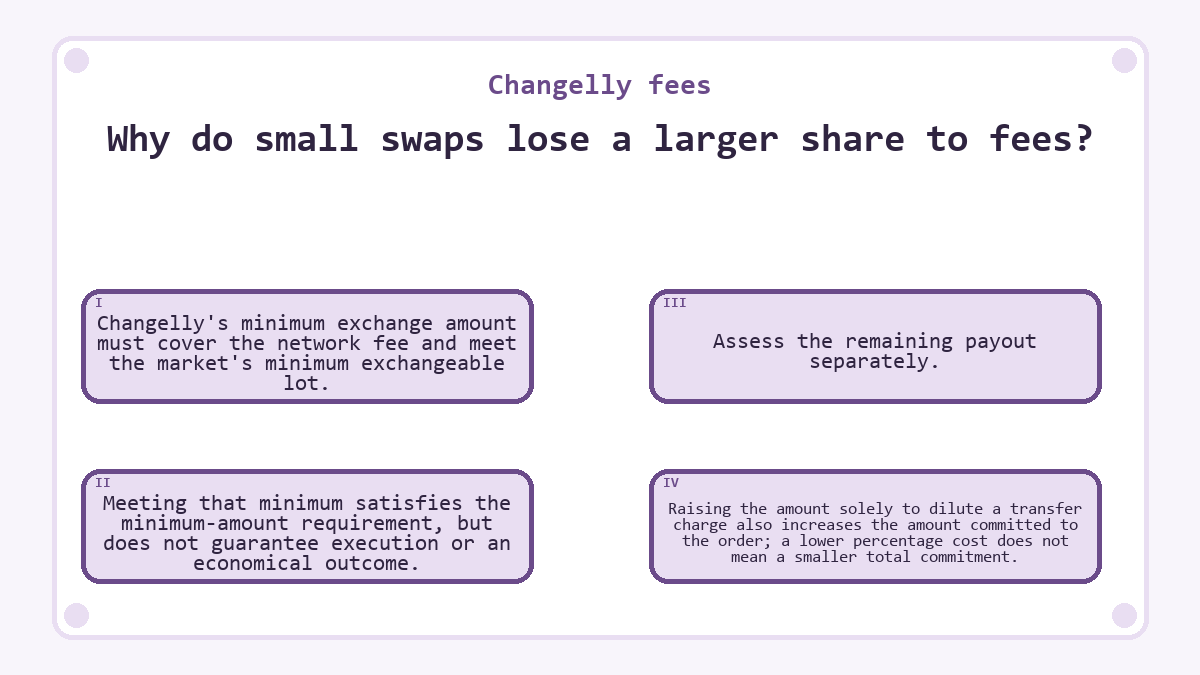
Changelly's minimum exchange amount must cover the network fee and meet the market's minimum exchangeable lot. Meeting that minimum satisfies the minimum-amount requirement, but does not guarantee execution or an economical outcome. Assess the remaining payout separately. Raising the amount solely to dilute a transfer charge also increases the amount committed to the order; a lower percentage cost does not mean a smaller total commitment.
Purchase costs before a later swap
A purchase funded with fiat currency has its own pricing, so its charges belong in the total when it precedes the swap.
The purchase provider's charge
Fiat providers determine the fees for purchases arranged through Changelly's marketplace. The purchase quote depends on factors that include the currency pair, location, and market conditions. A crypto exchange service percentage cannot substitute for that purchase quote. Keep the amount paid and cryptocurrency delivered as the purchase record, then evaluate any later conversion separately.
The extra conversion stage
Buying an intermediate asset and exchanging it afterward introduces a separate conversion into the cost calculation. Include the purchase cost, any transfer required to fund the swap, and the swap's net payout. Compare that complete route with a direct purchase only when both deliver the desired asset on a compatible network. The relevant outcome is the final usable balance for the same total expenditure.
The quoted payout and the completed exchange
The net receiving estimate and the completed payout answer different questions: what the order anticipates delivering, and what it actually sends.
A display labeled as an output amount is not automatically a net amount. In Changelly's floating transaction API, the expected payout field comes before the network deduction. The integration must subtract that deduction to calculate the expected net payout. This distinction matters when comparing an embedded exchange with another quote that already shows the amount after fees.
Subtracting the same deduction again understates the amount you expect to receive. Conversely, treating a gross output as spendable proceeds overstates it. Establish what the displayed number includes before calculating the difference between offers. The label, fee breakdown, and receiving estimate should describe the same amount.
A floating order's final amount may rise or fall because the execution rate changes. Separate that movement from identifiable charges when reviewing a discrepancy. A difference from the first estimate is not enough to assign the entire shortfall to fees.
The completed order amount, payout transaction, and destination receipt provide the records for reconciliation. Compare cryptocurrency units before considering their displayed fiat value. Retain the initial quote and its rate mode alongside those records. They preserve the basis of the comparison without treating an estimate as proof of the final delivery.
Refund deductions and recovery limits
A failed or incorrectly funded exchange can produce a refund with deductions, so cancellation or recovery should not enter the cost comparison as free.
Refunds can incur applicable network charges and additional recovery costs. An incorrectly sent transfer may require technical intervention, and some transfers cannot be recovered. Before agreeing to a proposed resolution, establish the return asset, compatible return network, deductions, and expected net amount. A recovery fee does not establish that every incompatible transfer is recoverable.
Very small deposits present another boundary: an amount below the network cost required for its return may be non-refundable. Keeping the original order above its minimum does not resolve a later mistake involving the wrong asset or network. Each issue changes the available resolution.
A repeatable comparison before sending
A useful quote comparison holds the input amount, destination asset, and receiving network constant, then distinguishes the costs outside each displayed payout. Capture offers close together in time. Record the rate mode and whether the receiving amount includes the payout network charge. Include any sending cost required by the funding wallet or exchange.
When both alternatives have the same total input cost and deliver the same usable asset, the larger net payout provides more cryptocurrency. When their funding costs differ, normalize the comparison to the same total expenditure before judging the offers. Keep a fixed quote's funding conditions beside its amount, rather than comparing it as an unconditional promise.
Decide whether an available quote delivers enough usable cryptocurrency for the total cost you would incur. Resolve any unclear deduction or network mismatch before committing funds. If the quote changes during that review, compare the replacement offer on the same basis.
Reader questions
Will splitting a Changelly swap into smaller orders reduce the total fees?
Splitting a swap can increase the combined transfer costs because each separate order may incur its own funding and payout charges. A percentage service charge alone does not establish a saving from splitting. Compare the combined net payouts and all sending costs with the single-order quote, while respecting the amount limits that apply to each option.
Is a lower fiat value in my receiving wallet evidence of an extra Changelly charge?
A lower displayed fiat value alone does not establish an extra charge. The wallet's valuation can change with market prices or use a different pricing reference. Compare the cryptocurrency quantity received with the completed payout amount first. Use a consistent valuation time when measuring economic cost; otherwise, the calculation also captures price movement after the exchange.
Does swapping back recover the cost of the original exchange?
A reverse swap is another exchange with its own quote and applicable charges. It does not undo the original conversion or reimburse its costs. The reverse rate can also differ from the rate used earlier. Evaluate the amount that the new order would return after deductions before treating a reverse swap as an economical exit.
What does the API's totalFee include?
The API defines totalFee as the sum of the network fee and Changelly's service fee amount. It reports partner commission separately, so that field alone does not describe every possible cost associated with an integrated exchange. The cost of sending the deposit also belongs outside that total.